Racing
 League
 Rugby
Rugby
 Football
 Cricket
 Golf
Golf
 Sport Nation
 Motorsport
 Netball
 Basketball
 Combat Sports
 Olympics
 Other Sports
 Bathurst 1000 from 12pm Sunday
Browne: The bricks and mortar of football
Ashley Browne • March 22nd, 2026 1:00 pm
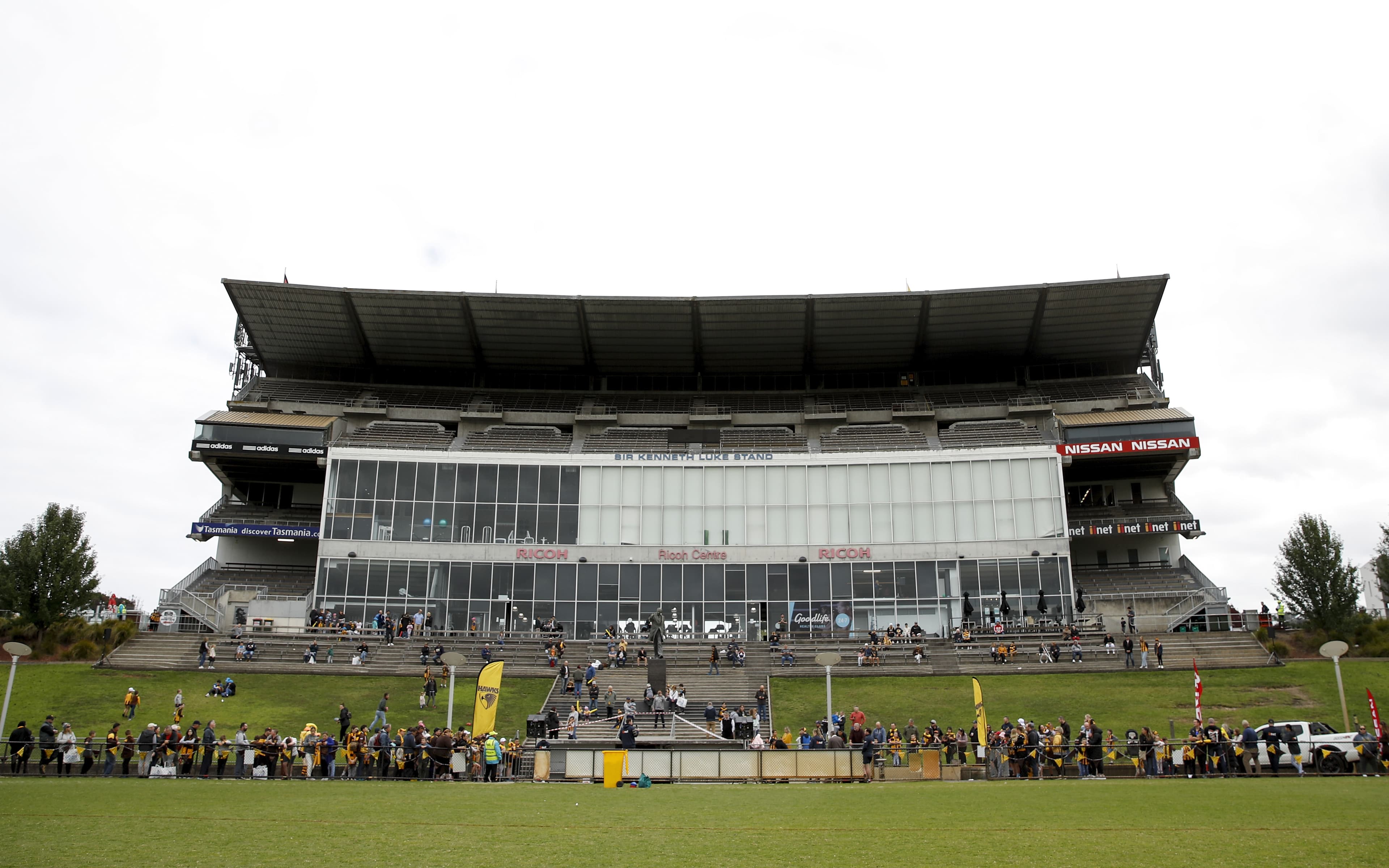
Just about everything in the AFL is supposed to be equal.
The salary cap? Probably the most important equalisation measure of all and certainly, the most well-policed by the AFL.
The draft? Good on paper but hopelessly compromised by lumpy and uneven rules around academies and father-son selections.
The fixture? Effectively splitting the competition into three groups works in theory, but it gets complicated by stadium agreements, rivalry games and TV requirements. And it will be back to the drawing board in 2028 when Tasmania enters the competition and not long after that, the inevitable 20th team.
Which leaves us with facilities, the one aspect of the game that is truly left to market forces.
The AFL will tip in some cash to help things along, and various levels of government can be relied on for assistance if there is a genuine commitment to opening the doors to community and grassroots sport, but basically, the free-market reigns supreme and the clubs are able to build whatever they can afford.
State-of-the-art training and administrative facilities have become footy’s last genuine arms race. And clubs have been spending big to stay ahead of the game.
Hawthorn became the latest club to move into shiny new digs when it opened its new $100 million home, the Kennedy Community Centre at Dingley last November, a move that took a decade to come to fruition. The Hawks fully own the entire 28-hectare facility, but are only using part of it and are hatching ambitious plans to develop what is left.
In 2024, Sydney moved a few hundred metres down Driver Ave from the SCG to the Sellers & Colless Centre, their new facility located in the repurposed Royal Hall of Industries, while the massive redevelopment of the Western Bulldogs’ home at Whitten Oval was finally completed.
But hard hats have been present at just about every AFL club over the past decade as clubs have built state-
of-the-art facilities geared around high performance, not just for the players and the football department, but for all staff members, as well as sponsors and supporters.
The Kennedy Community Centre is truly impressive, with its two ovals – one with the same dimensions as the MCG and the other the same size as Marvel Stadium but with all the requisite infrastructure to host AFLW and VFL games. The players and staff lack for nothing with no expense seemingly spared.
How much better it makes the Hawks remains to be seen although as coach Sam Mitchell told AFL.com.au, the early signs are promising.
“Moving to here, which doesn’t have a history, has been something I was mildly worried (about). But after being here, I can’t believe the difference that it’s made in a positive way, in almost everything,” he said.
“We don’t have every aspect of it right just yet. It’s a bit like we’ve moved house and we still have a couple of boxes in the corner and the art hasn’t gone up. But there is this … oh my goodness, this house is awesome, I’m so glad we moved.
“We’ve made a great call here. There are little things like 3.30pm and the players might be finished, so last year at 3.45, there’s not really anyone around.
“Now, I’ll leave at 5pm and there’ll still be 10 guys in the sauna or having a swim or in the ice bath. There’s a level of warmness about the whole building that makes everyone want to stay.”
When asked whether the KCC had helped him as a footballer, new co-skipper Jai Newcombe noted a broader energy.
“The warm-up area is massive as a midfielder for touch and getting reps and the gym from a physical standpoint, is first class, and is going to give us every chance,” he said.
“There are a few new machines in there that I don’t think too many other clubs have that hopefully is going to provide some help in the power areas, in terms of running technique and things like that.”
When the Swans rocked up for the first day of training in their new building in late 2023, coach John Longmire reminded them that without an appetite for hard work, that having the best facilities would count for nothing. Two years on and now the club’s executive director of club performance, he doesn’t resile from that.
“You have to do the work. This place isn’t going to do it for you,” he said.
But in an era when so much in the game is regulated, and especially when severe curbs on football department expenditure (the soft cap) were introduced by the AFL during the 2020 Covid season, and which remained in place well after, where you prepare to play becomes an important tool for player retention and recruitment. That certainly applies for clubs such as Sydney where up to 80 per cent of the playing group come from outside the state.
The same for support staff. The soft cap cuts meant working in the AFL was no longer as remunerative, and therefore as attractive to doctors, physiotherapists and others in the sports science field. There had to be a carrot.
“To have an A-grade facility like that is really important to attract top quality, high-end football department staff,” Longmire said.
He was intricately involved in the design of the new facility, together with the heads of medical services and sports science. The key to the building is that the modified indoor field sits in the middle of the complex with all areas of the club – football and commercial – looking towards it.
“The key component was flow,” he said.
“Flow from players, flow with staff, making sure you’re constantly interacting with each other, and there’s no pockets of areas that you that meant you weren’t interacting with someone.
“And importantly, this might sound strange, largely centred around food in our eating area, because great cultures, over many years have used food and where people congregate together as an important part of bringing a club together and having a really connected organisation.”
There were unintended benefits for the Swans. The short walk by the players down Driver Ave from headquarters to the SCG on match days has become an event, with supporters lining the street to cheer them on.
The players are back there shortly after games and can do their warm down and recovery while their families have a meal and their children can run around the indoor playing field having the time of their lives.
In terms of location, Sydney’s cannot be beaten – situated 10 minutes from each of Bondi, the airport and the CBD. Little wonder former Carlton star forward Charlie Curnow was smitten almost from the moment he stepped into the facility.
And it generates significant revenue for the club. When the Swans aren’t using it, the facility is available for hire and in addition to the club’s corporate partners,
groups ranging from ASX 200 companies to local schools hire it out for conferences and events.
“It’s flat out every day,” Longmire said.
“You walk in here, and there’s people either in the meeting rooms and or using the indoor training facility or the auditorium. It’s a wide range of people that use it and that’s incredible.”
But there are pitfalls. Players in the recent AFL State of Origin game were reportedly eyes agog when they set foot inside West Coast’s headquarters in suburban Lathlain as they prepared for the game.
But Adam Simpson preaches caution. He was West Coast’s premiership coach in 2018, working out of a tired facility at Subiaco Oval that he nevertheless loved.
But the Eagles moved the following summer, and the club’s decline started shortly afterwards.
“There was no history there,” he said, recalling battles with the facilities staff just to get some pictures placed on the walls inside what is now Mineral Resources Park.
“I think anyone who thinks it’s going to be the difference, it’s a good sales point. So, when you’re attracting staff or players, you show them all the good parts, but there’s that risk that you lose your soul.
“It was sterile and we were constantly looking at ways to make the environment better.”
Simpson played in two North Melbourne premierships in the 1990s when the club was based in decrepit facilities at Arden St. He noted that Essendon’s move to The Hangar from Windy Hill in 2013 hasn’t translated into any meaningful success and will keenly observe how the Hawks fare this year now they are in their new building.
“There’s a difference between upskilling your old facility and moving to a new suburb. I worked at Hawthorn at Waverley but there’s some stuff there that you’ve got to get around such as different travel for the players,” he said.
“If someone’s living in Albert Park and now driving to Dingley every day, they can’t be doing this the whole time, can they?
“I just think, having come from North, that the whole facilities thing is over-rated, but when I went to Sydney recently, I caught up with ‘Horse’ (Longmire) and went through their facility, it is brilliant.”
Truth is that most new facilities give the clubs what they need. For the Hawks, Eagles and Bombers, it is having two different-sized ovals, meaning they are always preparing in pristine conditions and in conditions helpful for upcoming games.
Collingwood can offer its prized location a few hundred metres from the MCG. Players walk back to the club after games to do their recovery.
Carlton’s home at Ikon Park has undergone a few renovations but now features an in-house medical centre. No longer do the Blues have to dodge those pesky reporters outside Victoria House on the other side of town when they go for a Monday morning scan.
The Lions moved from the Gabba to the ’burbs and have yet to miss a Grand Final since making Springfield their home.
St Kilda’s move to Seaford in 2011 “crushed” the players according to then skipper Nick Riewoldt but the return to Moorabbin in 2020 allowed the club to rediscover its soul. And as last year’s player movement period demonstrated, it’s a carrot to lure players to the club.
Others are playing catch-up. Port Adelaide’s Alberton facility is being expanded to give the AFLW program equal footing, while Adelaide’s impending move from West Lakes (the old Football Park) to inner-city Thebarton will give the Crows a facility the equal of any club in the AFL.
It took tearing down the beloved Jack Dyer Stand at Punt Rd to do so, but Richmond will lack for nothing when its revamped home base opens sometime next year.
And then there’s Melbourne. Depending on who you believe, the Demons dallied 25 years ago when it had the first option on moving to the Olympic Park precinct. Collingwood seized the moment and relocated to the old Olympic swimming pool and surrounds in 2004.
Melbourne’s interminable search for a home base that will finally unite all parts of the club under one roof continues.
“I won’t miss driving down to Casey,” former coach Simon Goodwin said after his sacking last year and who could blame him?
Melbourne’s administration has long been based at the MCG, while the football operations are split between nearby Gosch’s Paddock and Casey Fields, located nearly 50km away.
The Demons have long-term plans to relocate to Caulfield racecourse, but that might be up to a decade away. In the meantime, a temporary relocation to the Hawthorn’s former base at Waverley is likely, which is a touch ironic given Waverley was first built as a bulwark against the powerful Melbourne Cricket Club nearly 60 years ago.
It is not the ideal solution, but having the entire club under one roof gets the Demons back in the game. For too long, Melbourne has brought a blunt knife to the proverbial gun fight that is the football facilities arms race.